
Grasslands and Heathland
Suffolk’s heathlands, chalk grasslands and the unique grass-heath of the Brecks represent three distinct but ecologically related expressions of nutrient-poor, low-productivity land. Together they contain some of the county’s most threatened and most important species, and all three have suffered severe losses over the past century.
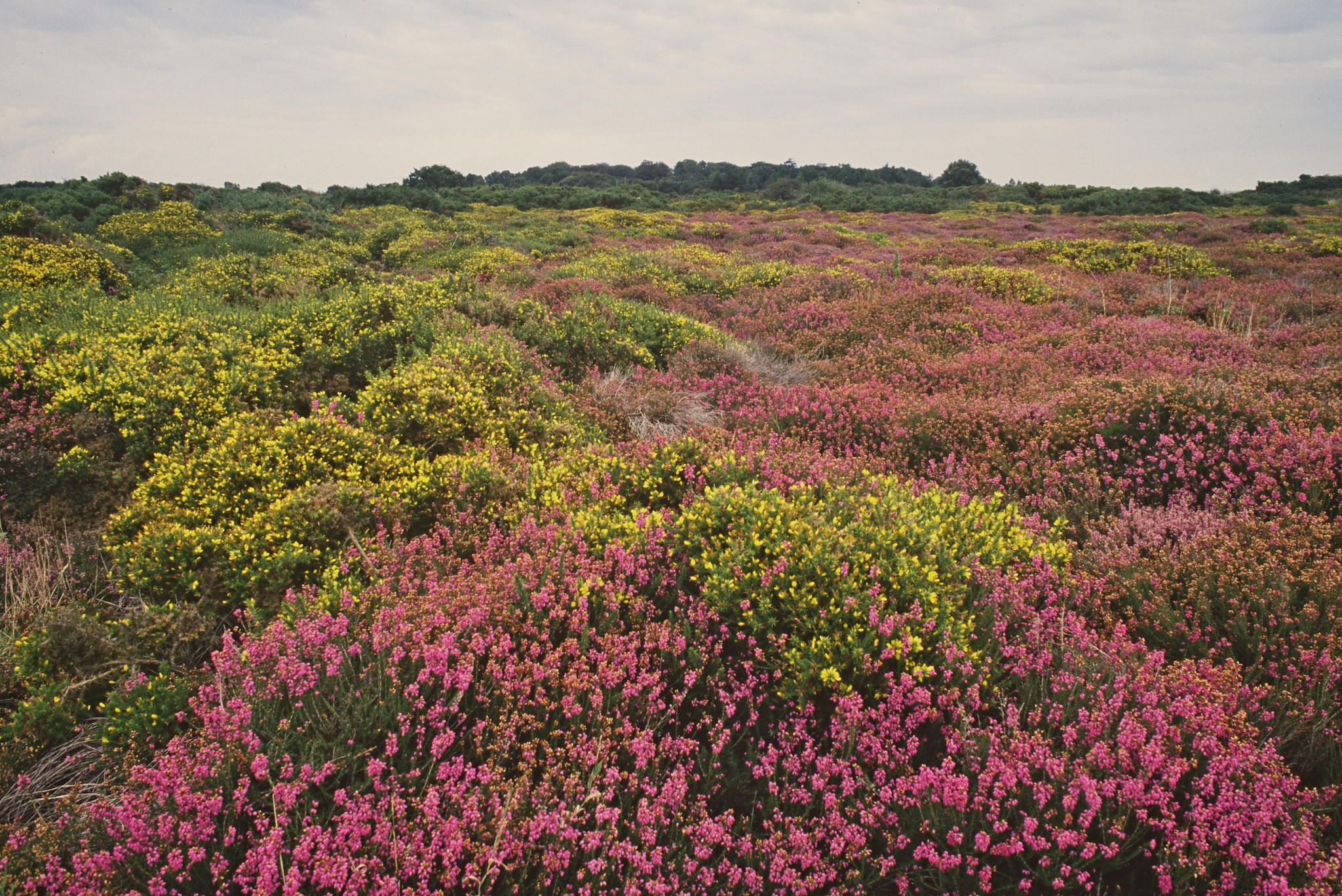
The Sandlings heathlands of the Suffolk coast and estuary belt were once extensive enough to define the region’s character, their open, purple-flowered expanses stretching between Ipswich and Southwold. Agricultural improvement, afforestation and development have reduced them to fragments, but what remains – at Sutton Heath, Dunwich Heath and Westleton Heath, among others – supports assemblages of heathland birds, reptiles and invertebrates that are among the best in lowland England. The nightjar (Caprimulgus europaeus) and woodlark are characteristic breeding species, and the nightjar’s churring call on a summer evening is one of the most evocative sounds in the Suffolk countryside. Nationally, over 80% of lowland heathland has been lost since 1800.
Suffolk’s chalk grasslands, concentrated in the west of the county, are species-rich in proportion to their extent, supporting communities of wildflowers and specialist invertebrates on shallow, calcium-rich soils. Rockrose (Helianthemum nummularium) is the assemblage’s chalk grassland flagship, its presence indicating the undisturbed, nutrient-poor conditions that chalk downland communities require.
The Breckland, straddling the Suffolk–Norfolk border, is unlike anywhere else in Britain. Its continental climate, low rainfall, and sandy, free-draining soils have produced a grass heath of exceptional rarity, characterised by mosses, lichens, and a flora influenced by steppe and boreal communities. The stone-curlew (Burhinus oedicnemus), which nests on bare stony ground in traditional Brecks arable and grass heath, has recovered significantly through targeted management, and the Brecks now hold the largest stone-curlew population in the UK. All three habitat types within this assemblage are under pressure from scrub encroachment, nitrogen deposition, and the cessation of traditional grazing, making active management essential.
Key
Listed as a conservation priority in Suffolk’s Biodiversity Action Plan.
Identified as a key priority for recovery under Suffolk’s Local Nature Recovery Strategy.


Associated habitats
Road verges with species-rich sward: The roadside verges of Suffolk collectively represent an extensive network of semi-natural grassland, and at their best they support a diversity of wildflowers, grasses and invertebrates comparable to traditional hay meadow. Where verges lie on chalky or sandy soils and have avoided improvement, they can hold populations of cowslip, ox-eye daisy, knapweed, and wild carrot. Cutting management is important – verges cut too early or too frequently lose much of their wildlife value.
Scrub–grassland mosaics: Where scrub and open grassland intermix at a fine scale, the resulting mosaic supports a greater diversity of species than either habitat could provide independently. The sheltered, warm microclimates created at scrub edges are particularly favoured by invertebrates, reptiles and small mammals, while the open areas provide foraging habitat for birds and pollinators. Maintaining a dynamic balance between encroaching scrub and open sward – through rotational cutting or grazing – is central to effectively managing this habitat type.
Chalk scrub and scrub margins: Where scrub encroaches onto or borders chalk grassland, a diverse transitional zone develops that supports species from both habitats alongside specialist scrub-edge communities. Hawthorn, dogwood, wayfaring tree and traveller's joy are typical components in Suffolk’s chalk country, providing food and shelter for warblers, finches and a range of invertebrates. Carefully managed scrub margins – neither fully cleared nor allowed to close over – often hold the highest biodiversity value.
Heath–grassland mosaics: The intimate mixing of heathland and grassland within a single landscape creates a structural and botanical diversity greater than either habitat alone. These mosaics arise where management varies across a site or where underlying soil conditions shift over short distances. They are particularly valuable for invertebrates, reptiles and ground-nesting birds that require access to multiple habitat types within a small home range.
Image: Minsmere-Walsberswick Heath © Natural England/Peter Wakely