
Traditional Orchards
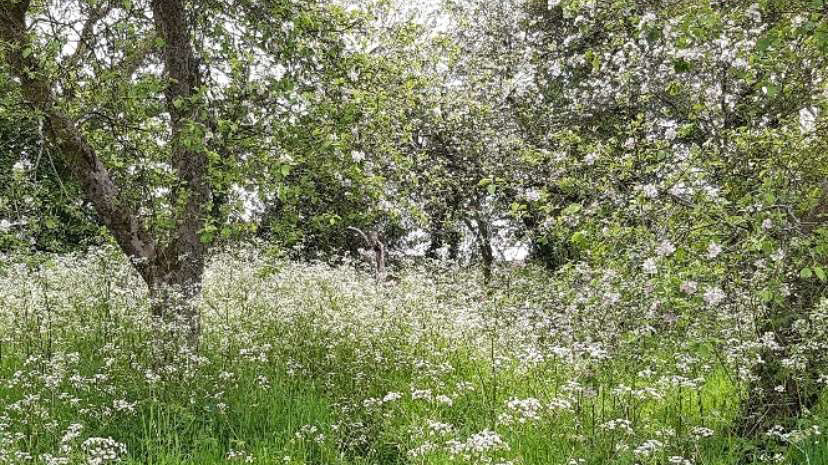
Traditional orchards are among the most distinctive and ecologically rich features of the Suffolk countryside. Defined by widely spaced standard or half-standard fruit trees – apple, pear, plum, cherry, damson, walnut and cobnut – grown over unimproved grassland on vigorous rootstocks, they support wildlife communities found in very few other habitats. The rough, furrowed bark of aging fruit trees, progressive heartwood decay and the continuity of an unimproved sward create conditions of exceptional ecological value. Suffolk has a strong tradition of orchard cultivation; the county’s claylands were historically rich in orchard heritage, and documented examples range from small village plots to larger estate orchards with trees of considerable age and complexity.
Defining features
- A planting of five or more fruit or nut trees – including apple, pear, plum, cherry, damson, walnut and cobnut – with canopies no more than 20 metres apart.
- Trees grown as standards or half-standards on vigorous rootstocks, giving them the potential to develop veteran characteristics over time. Trees may be multi-stemmed or have very short trunks; cobnuts and hazels are not routinely coppiced.
- Sufficient age and spacing to allow veteran tree features to develop: rough and furrowed bark, hollows, cavities and decaying heartwood.
- An unimproved or semi-improved grassland floor that is not mown short, supporting a diverse community of flowering plants, fungi and invertebrates.
- Associated features – including scrub, hedgerows, fallen deadwood and ponds – that increase the habitat’s overall value for wildlife.
Importance for wildlife
Traditional orchards are the only Priority Habitat recognised for the combined importance of both the fruit crop – with its remarkable diversity of local and traditional cultivars – and the habitat structure itself. As fruit trees age, they develop the same veteran characteristics that make ancient wood-pasture trees so ecologically significant: rough and furrowed bark supporting epiphytic lichens and mosses; hollows and cavities providing nest and roost sites for birds and bats; and decaying heartwood creating conditions for saproxylic invertebrates, including the nationally scarce Noble Chafer beetle and the Orchard Tooth fungus, one of the rarest species in Britain.
The grassland floor is equally important. Where it is managed by light grazing or late cutting rather than intensive mowing, it supports a rich community of flowering plants, grassland fungi and invertebrates. The structural complexity of a well-managed orchard – open-grown fruit trees combined with scrub, hedgerows, rough grassland, fallen deadwood and associated features such as ponds – creates a mosaic that attracts a wide range of species, from hole-nesting and scrub-nesting birds to foraging bats, reptiles, amphibians and moths. Traditional cultivars also provide a critical food resource in autumn and winter, when fallen and unharvested fruit sustains species including Redwing, Fieldfare and Hedgehog through leaner periods.
Important associated species
Species marked * are Suffolk Priority species. Species marked ** are Priority – Research Only: common and widespread, but rapidly declining.
- Beetles
Stag Beetle, Noble Chafer
- Birds
Dunnock, Tree Sparrow, Starling, House Sparrow, Bullfinch, Song Thrush, Cuckoo, Hawfinch, Lesser Spotted Woodpecker, Spotted Flycatcher, Marsh Tit, Turtle Dove, Linnet
- Fungi and Slime Moulds
- Mammals
Hazel Dormouse, Harvest Mouse, Hedgehog, Common Pipistrelle *, Soprano Pipistrelle
- Moths
Goat Moth, Knot Grass **, Brown-spot Pinion **, Beaded Chestnut **, Green-brindled Crescent **, Mouse Moth **, Large Nutmeg **, Centre-barred Sallow **, Dark Brocade **, Mottled Rustic **, Figure of Eight **, September Thorn **, Dusky Thorn **, August Thorn **, Spinach **, Garden Dart **, Small Emerald **, Ghost Moth **, Rustic **, Rosy Rustic **, Lackey **, Brindled Beauty **, V-moth **, Dot Moth **, Rosy Minor **, Buff Ermine **, Pale Eggar **, Cinnabar **, Dark-barred Twin-Spot Carpet **
- Reptiles and Amphibians
Common Lizard, Grass Snake, Slow-worm, Great Crested Newt, Common Toad
Factors affecting this habitat in Suffolk
- Loss to development, garden conversion and conversion to pony paddocks. Traditional orchards are typically found in small patches within or adjacent to settlements, making them particularly vulnerable to these pressures.
- Declining commercial viability: traditional orchards are less economically productive than modern intensive fruit-growing operations, placing older and smaller examples – particularly in the mid-Suffolk claylands – under sustained pressure.
- Neglect and inappropriate tree management, including incorrect pruning, failure to replace trees as they are lost, and removal of deadwood that is essential for specialist invertebrates.
- Inappropriate or absent grazing: too intensive a regime damages root zones and suppresses flowering plants; too little allows rank grass and invasive scrub to establish.
- Poor grassland management, including over-frequent cutting, the application of fertilisers and herbicides, and failure to maintain the diversity of the sward beneath the trees.
- Tree pests and diseases, including bacterial canker, brown rot and emerging threats from invasive invertebrates such as the brown marmorated stink bug.
Habitat management advice
- Ensure continuity by planting young trees to replace those lost, using locally sourced traditional varieties where possible. Graft from existing trees to preserve rare or local cultivars that would otherwise be lost.
- Plant a mix of early, mid and late-flowering varieties to extend the foraging season for pollinators across spring and early summer.
- Retain deadwood in all its forms: standing decaying trunks, hollow limbs, cracks in bark, rot holes and sap runs all support saproxylic invertebrates and provide nest and roost sites for birds and bats. Where pruning is unavoidable, stack removed material nearby as log and brushwood piles.
- Leave unharvested fruit on trees or where it falls: fallen fruit is a critical food resource for birds and mammals in autumn and winter.
- Manage the grassland floor carefully. Use late and staggered cutting to allow plants to set seed, leave an uncut strip for overwintering invertebrates, remove cuttings to reduce soil fertility, and avoid fertilisers. Low-fertility grassland supports the greatest diversity of flowering plants and grassland fungi.
- Maintain some areas of shorter grass as habitat for grassland fungi, while leaving patches of nettles – the larval food-plant of several butterfly species – and bramble, which provides late-season nectar, a good supply of fruit and thorny cover for invertebrates.
- Maintain a suitable grazing regime where possible: sufficient to control invasive scrub and sustain a dung supply for specialist invertebrates, but light enough to protect tree root zones and retain flowering plants.
Suffolk’s orchard heritage
Suffolk has a richer tradition of orchard cultivation than might be expected from an arable-dominated county. The Suffolk Traditional Orchards Research Group has identified and recorded hundreds of orchard sites across the county, from small domestic plots to larger estate and village orchards with trees of considerable age. The claylands of mid-Suffolk, where pastoral farming traditions persisted longest, retain a particularly strong concentration of surviving orchard remnants; several contain apple, pear and plum cultivars no longer found in commercial production. Details of recorded orchard sites, together with guidance on identification and management, are available through the SBIS Traditional Orchards resource.
Vision for Suffolk
The following priorities reflect the strategic goals for traditional orchards in Suffolk, drawing on both the Biodiversity Action Plan framework and the Local Nature Recovery Strategy.
- Improve knowledge of the extent and condition of traditional orchards across the county.
- Maintain the existing extent of traditional orchards to ensure no net loss.
- Re-create traditional orchards where opportunities arise, prioritising sites with links to local fruit-growing heritage and using locally appropriate cultivars.
- Encourage the restoration and improvement of degraded traditional orchards, including those that have been neglected or have lost their characteristic ground flora.
Further information
- Barnes, G. and Williamson, T. (2021) The Orchards of Eastern England: History, Ecology and Place. University of Hertfordshire Press
- FruitID – Fruit variety identification website
- JNCC – Habitat description: Traditional Orchards (PDF)
- MAGIC – Interactive mapping including designations
- Natural England – Traditional orchards: information notes
- People’s Trust for Endangered Species – Traditional orchards: a guide to wildlife and management (PDF)
- Suffolk Wildlife Trust – Habitats Explorer: Orchards
- Making Space for Nature – Lawton Review, Defra, 2010 (PDF, historical reference)
- The Natural Choice: Securing the Value of Nature – Natural Environment White Paper, 2011 (PDF, historical reference)
Suffolk’s Non-Woodland Tree Habitats
Key
A conservation priority in Suffolk’s Historic Biodiversity Action Plan.
A key habitat for recovery under Suffolk’s Local Nature Recovery Strategy.


Traditional orchards are primarily a part of the Non-Woodland Trees habitat group, but also feature in these habitat groups: Farmed Landscapes and Wider Countryside, Meadow and Pasture and Urban, Built and Garden.
Image: A traditional orchard by Paul Read
 Archived BAP action plan, 2007 (PDF) Superseded – provided for historical reference only.
 Suffolk BAP action plan for Traditional Orchards (PDF, 2007)
